
Dojo Etiquette
Etiquette (reigi) is fundamental to martial arts training. These customs and behaviors show respect for your instructors, fellow students, the dojo, and the art itself. Understanding and practicing proper etiquette creates a positive training environment for everyone.
Why Etiquette Matters
Etiquette in the dojo isn't about formality for its own sake - it serves important purposes that enhance training and build character.
Shows Respect
Demonstrates respect for your instructors, training partners, and the martial arts tradition you're part of.
Ensures Safety
Many etiquette rules exist for safety - following them prevents accidents and injuries during training.
Develops Discipline
Practicing proper etiquette cultivates self-discipline, awareness, and mindfulness both in and out of the dojo.
Builds Community
Shared customs create a sense of unity and belonging, fostering a positive training atmosphere for everyone.
Reigi (η€Όε) - The Way of Respect
Reigi (pronounced "ray-ghee") is the Japanese term for etiquette or proper behavior. In martial arts, reigi encompasses all the customs, manners, and respectful behaviors that define conduct in the dojo. Practicing reigi is as important as practicing techniques - it's an integral part of your karate training.
The Bow (Rei)
The bow is the most fundamental expression of respect in Japanese martial arts. It's not religious - it's a physical gesture showing humility, respect, and gratitude.
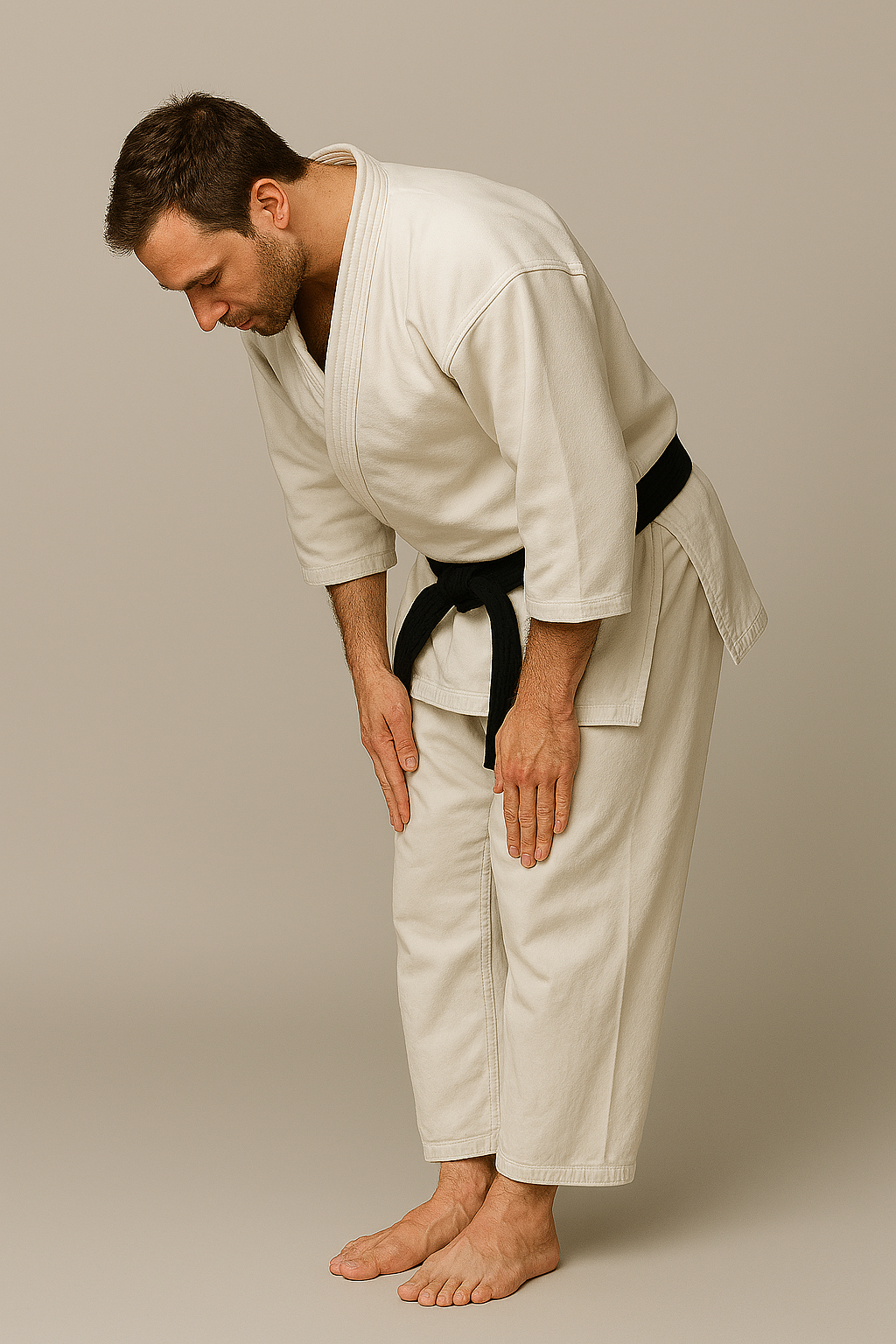
Standing Bow (Ritsurei)
When: Entering/leaving the dojo, greeting instructors, before/after partner work
How:
- Stand in natural stance (heiko dachi) with feet shoulder-width apart
- Keep your back straight and eyes forward
- Bend forward from the waist approximately 30 degrees
- Pause briefly at the bottom of the bow
- Return to upright position smoothly
- Keep hands at your sides or on your thighs
Tip: The bow should be deliberate and respectful, not rushed.
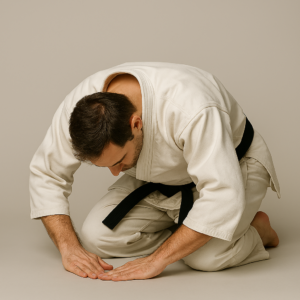
Kneeling Bow (Zarei) - Seiza Position
Kneeling Bow (Zarei)
When: Formal ceremonies, beginning/end of class, meditation
How:
- Kneel down, left knee first, then right knee
- Sit back on your heels in seiza position
- Rest hands on your thighs
- Bow forward, placing hands flat on the floor forming a triangle
- Lower your forehead toward (but not touching) your hands
- Pause briefly, then return to upright seiza position
- To stand: right foot up first, then left
Tip: If kneeling is difficult due to injury or flexibility, a standing bow is acceptable.
When to Bow
Entering/Leaving: Bow when entering or leaving the dojo training area
To Instructors: Bow when addressing or being addressed by an instructor
Class Start/End: Formal bow at the beginning and end of every class
Partner Work: Bow to your partner before and after practicing together
Receiving Instruction: Bow after receiving individual correction or instruction
Shomen: Bow to the front of the dojo (shomen) at formal occasions
General Dojo Rules
These fundamental rules apply in all GKI dojos and help maintain a respectful, safe training environment.
Entering and Leaving the Dojo
- Always bow when entering or leaving the training area
- Arrive on time - ideally 10-15 minutes early to change and warm up
- If you arrive late, wait at the edge of the training area until acknowledged by the instructor
- Never leave class early without permission from your instructor
- Remove shoes before stepping onto the training floor
Personal Appearance and Hygiene
- Wear a clean, properly tied gi (uniform) with appropriate belt
- Keep fingernails and toenails trimmed short for safety
- Remove all jewelry before training (wedding rings may be taped)
- Tie long hair back securely
- Maintain good personal hygiene - shower before training when possible
- Ensure gi is washed regularly
Behavior During Class
- Pay full attention to the instructor at all times
- Stand in proper stance (heiko dachi or musubi dachi) when listening to instruction
- Never lean against walls or sit unless instructed to do so
- Don't talk or laugh during instruction - maintain focus
- If you need to adjust your gi, turn away from the front and do so quickly
- Ask questions respectfully and at appropriate times
- Practice with full effort and intensity
Addressing Instructors
- Address instructors as "Sensei" (teacher) or by their title
- Black belts may be addressed as "Sensei" out of respect
- Always bow when addressing or being addressed by an instructor
- Use "Osu" (pronounced "oss") to acknowledge instruction
- Never argue with an instructor - questions should be asked respectfully
- Follow instructions immediately without hesitation
Training with Partners
- Always bow to your partner before and after practicing together
- Thank your partner after training - say "Arigato gozaimashita" (thank you)
- Be respectful and courteous to all training partners
- Train with control - your partner is helping you learn, not your enemy
- Match your intensity to your partner's ability level
- If your partner is injured or uncomfortable, stop immediately
- Higher grades should help lower grades learn
Safety and Health
- Inform your instructor of any injuries or health conditions before class
- Stop training immediately if you feel pain or discomfort
- Never practice techniques outside your skill level without supervision
- Use control at all times - power comes with experience
- Inform your instructor if you see unsafe behavior
- Keep the training area clean and free of hazards
- If you're ill or contagious, stay home and recover
The Golden Rule
Above all else: Respect everyone and everything in the dojo. Your instructors, fellow students, the training space, and the art itself all deserve your respect. When in doubt about proper behavior, think about what would be most respectful.
Common Etiquette Terms
Understanding these Japanese terms helps you participate fully in dojo customs and shows respect for the art's origins.
Osu (ζΌεΏ)
Pronounced: "OSS"
Universal acknowledgment - used to say yes, I understand, hello, goodbye, thank you
Rei (η€Ό)
Pronounced: "RAY"
Bow - the command to bow
Sensei (ε η)
Pronounced: "SEN-say"
Teacher or instructor - literally "one who has gone before"
Dojo (ιε ΄)
Pronounced: "DOH-joh"
Training hall - literally "place of the way"
Gi (η)
Pronounced: "GHEE"
Training uniform (also called "dogi" or "karate-gi")
Onegaishimasu (γι‘γγγΎγ)
Pronounced: "oh-neh-GUY-shee-mas"
"Please" or "please teach me" - said at the start of class or partner work
Arigato Gozaimashita (γγγγ¨γγγγγΎγγ)
Pronounced: "ah-ree-GAH-toh go-zai-MASH-ta"
"Thank you very much" (past tense) - said at the end of class or after partner work
Shomen (ζ£ι’)
Pronounced: "SHOW-men"
The front of the dojo or the place of honor where we bow
Seiza (ζ£εΊ§)
Pronounced: "SAY-zah"
Formal kneeling position - sitting on heels
Mokuso (ι»ζ³)
Pronounced: "moh-KOO-soh"
Meditation or quiet reflection - usually done at the start/end of class
Yame (ζ’γ)
Pronounced: "YAH-may"
Stop - command to stop and return to ready position
Hajime (ε§γ)
Pronounced: "ha-JEE-may"
Begin - command to start
Don't worry if you don't remember all these right away! Your instructors and fellow students will help you learn them naturally over time. The most important ones to know at first are "Osu," "Rei," "Sensei," and "Arigato gozaimashita."
For Parents and Visitors
Watching Classes
- Parents are welcome to watch their children train
- Please remain quiet during instruction so students can focus
- Avoid calling out to your child or giving instructions - let the instructor teach
- Keep younger siblings supervised and quiet
- Photography/video may be restricted - check with your instructor
Mobile Phones
- Turn phones to silent mode in the dojo
- Students should not have phones on the training floor
- If you must take a call, step outside the training area
- Don't use phones during demonstrations or ceremonies
Photography and Video
- Always ask permission before photographing or filming
- Never film other people's children without parental permission
- Respect privacy - some students may not want to be filmed
- Don't post photos/videos on social media without permission
Supporting Training at Home
- Encourage regular attendance and practice
- Help your child remember their gi and belt
- Provide a space for home practice if possible
- Show interest in what they're learning
- Reinforce respect and discipline at home
